

If your energy, pain tolerance, and recovery shift throughout the month, you’re not inconsistent. You’re cyclical. Women’s hormones are wired directly into the brain’s pain system, influencing inflammation, blood flow, and how intensely pain signals are perceived. Once you understand the mechanism, what feels like unpredictability starts to look more like a map.
The Hormone–Pain Connection
When estrogen is stable and high, the brain’s built-in painkiller system works better, releasing more endorphins and activating more of the receptors built to receive them. When it drops — in the week before your period, postpartum, or during perimenopause — pain sensitivity rises, recovery slows, and fatigue gets heavier. Progesterone has its own role: natural anti-inflammatory and calming effects on the nervous system. The drop in both hormones right before menstruation is what sets off the more difficult symptoms of the late cycle.
The same woman, measured at a low-estrogen point in her cycle, shows measurably reduced capacity to activate her own pain-relief system compared to a high-estrogen point. Hormonal state, not constitution, is the variable.
Three Seasons. Three Sets of Rules.
For Young Women and Athletes
Your body is giving you real information every single month. Most training programs were built without any of it.

Menstrual cramps have a specific mechanism. In the days before and during menstruation, the body produces compounds called prostaglandins (hormone-like chemicals that trigger muscle contractions), which cause the uterus to contract and simultaneously restrict blood flow to uterine tissue. The result is oxygen deprivation in the muscle — the same mechanism that causes pain in a cramp anywhere else in the body. The intensity scales directly with how much prostaglandin is produced. Measurable, documented, and entirely physical in origin.
Roughly 10% of women who menstruate experience period pain severe enough to interfere with daily functioning for one to three days per cycle. It’s one of the most common gynecological conditions in the world — and one of the most undertreated.
The hormonal picture goes further than cramps. Estrogen affects the flexibility of ligaments and connective tissue throughout the body. Near ovulation, when estrogen peaks, joints become measurably looser — and for every additional millimeter of knee displacement, ACL injury risk goes up fourfold. Female athletes are two to eight times more likely to tear their ACL than male athletes in the same sports. The disparity traces directly to a hormonal variable that athletic training largely ignored until recently.
Elite programs now call the response to this load precision: adjusting training intensity, recovery volume, and injury-prevention work by hormonal phase. Near ovulation — more deliberate stability work. Late cycle and menstruation — lower performance intensity, higher recovery inputs. Not backing off. Recalibrating. The athletes who do this report fewer injuries and better performance over full seasons.
What to actually do:
For circulation-based menstrual pain, frequency matters more than duration. Ten minutes of targeted heat, movement, or electrotherapy applied consistently outperforms a single long session once a week. The body responds to repeated, brief inputs. The signal accumulates.
↳ Omega-3 fatty acids (fish oil or high-EPA/DHA algae supplement) compete with the fatty acids that prostaglandins are built from, shifting the body toward producing less of the compounds that cause cramping. A pooled analysis of 881 women across eight studies found a large reduction in pain — and the effect got stronger the longer supplementation continued. Plan for two to three months to see the full shift.
↳ Magnesium glycinate (not magnesium oxide, which absorbs poorly) relaxes smooth muscle and suppresses prostaglandin production directly. Multiple clinical trials show significant reductions in cramp severity. Two-thirds of American women are below recommended intake, and athletes deplete it further through training and stress.
For Women in the Middle (35–50)
You didn’t imagine the shift. Your chemistry changed.
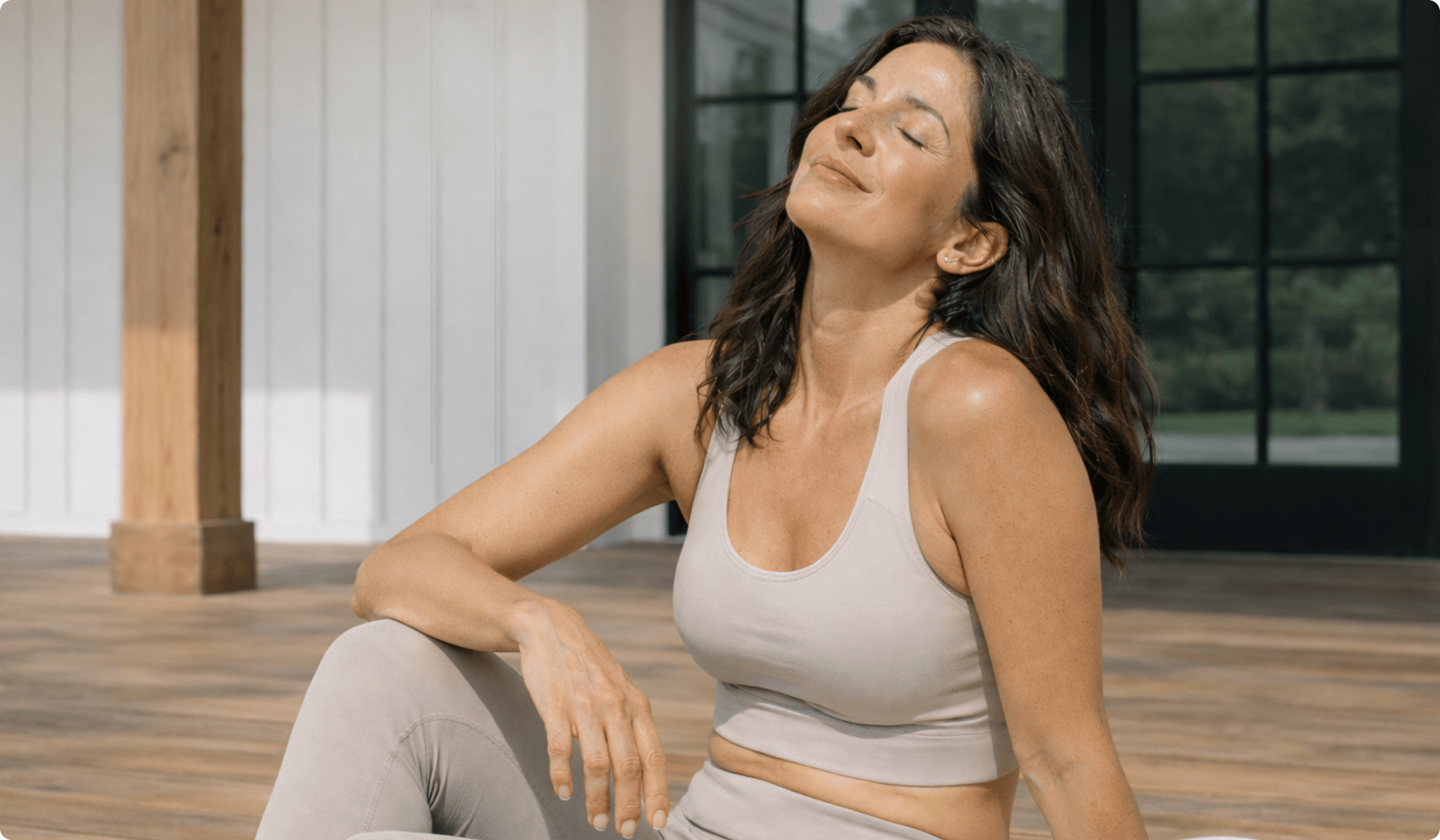
A tiredness that sleep doesn’t touch. Tension in your neck and shoulders that just lives there now. The low-grade headache. The feeling your body is running at a slightly higher temperature of stress, all the time, even when things are objectively fine.
Biochemistry explains it. The answer starts with cortisol.
Chronic stress keeps cortisol elevated, and cortisol competes directly with sex hormones. When it stays high, the body deprioritizes estrogen and progesterone production. The downstream effects are predictable: increased pain sensitivity, worsened inflammation, disrupted sleep, heightened nervous system reactivity. They make complete sense once you see the mechanism.
The physical symptoms of chronic cortisol elevation — persistent muscle tension in the neck, shoulders, and lower back; fatigue that sleep doesn’t resolve; tension headaches — are the same symptoms most commonly reported by women in their 30s and 40s managing high workloads. The overlap is biochemical.
The cortisol-estrogen relationship works in both directions. Three things that bring cortisol down with real science behind them:
What to actually do:
↳ The physiological sigh — Two short inhales through the nose, fully inflating the lungs, then one long slow exhale. Repeat 5–10 times. Stanford research found this specific pattern lowers the stress response faster than any other breathing technique tested, including box breathing and meditation. The longer exhale activates the vagus nerve (the main nerve connecting brain to body’s rest-and-recovery system), signaling the heart to slow. Two minutes. No equipment.
↳ Brief cold exposure — End your shower with 2–3 minutes of genuinely cold water. This produces a large spike in norepinephrine (an alertness and mood chemical) that persists for hours. More usefully: with repeated exposure over weeks, the stress response habituates. The body learns to stop treating every demand as a full emergency. One of the few documented ways to train your stress response toward lower reactivity over time.
↳ Real social connection — The tend-and-befriend stress response identified by Shelley Taylor at UCLA is driven partly by oxytocin (the bonding hormone), which directly dials down the body’s stress response. Quality is the key word: reciprocal, supportive interactions produce the response. Passive scrolling doesn’t. A 20-minute conversation with someone you trust has measurable cortisol effects that a 20-minute social media session does not.
For Caregivers (50+)
Your body has been keeping score. That’s not a weakness — it’s a data point.
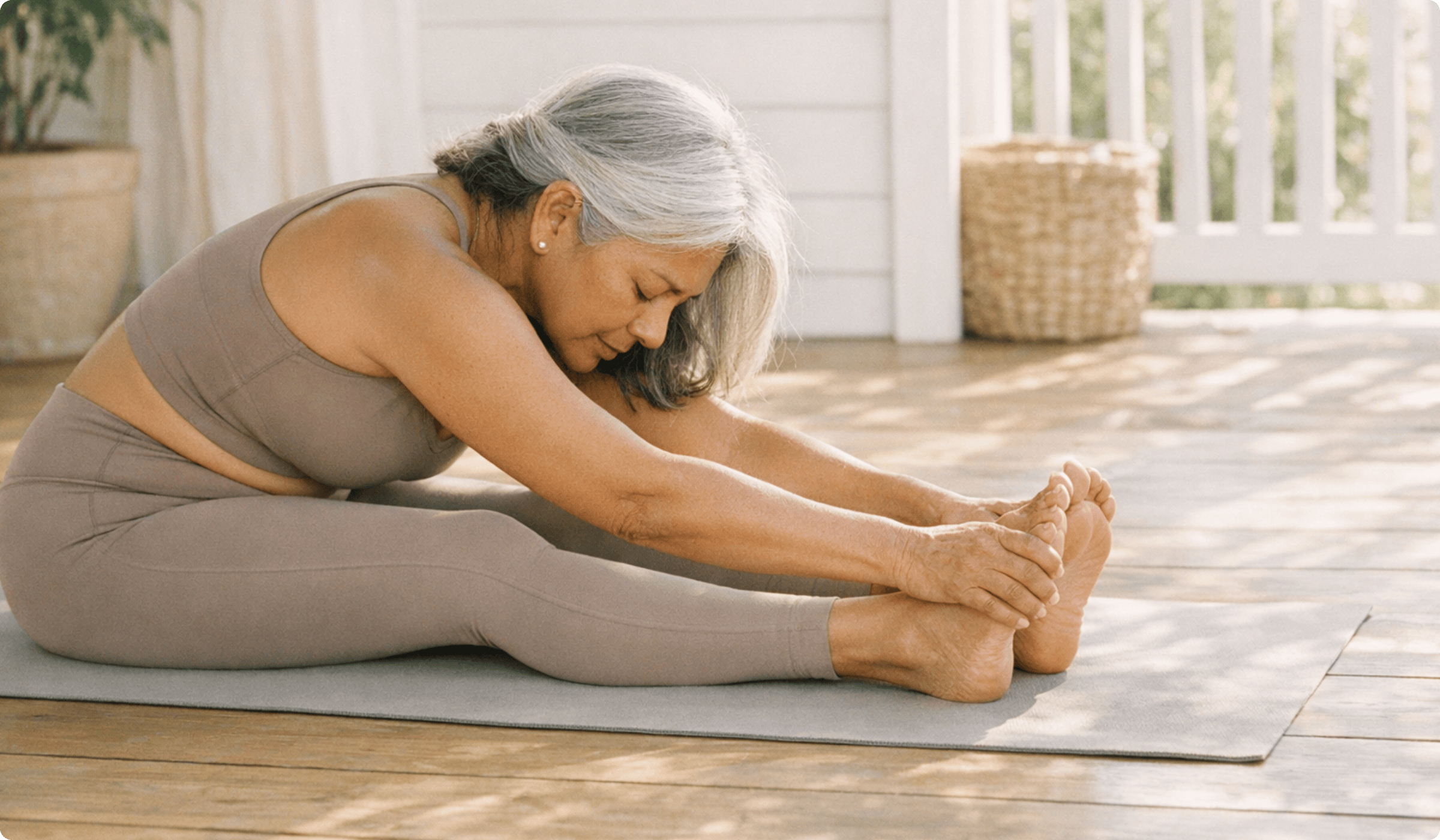
Caregiving is physical work. The lifting, the repositioning, the hours on your feet, the sleep that gets interrupted and never fully recovers. And underneath it, the kind of stress that has no clean boundary, no end-of-day switch, no point at which you can fully set it down.
Your nervous system has been registering all of it.
Chronic caregiving stress keeps cortisol elevated, suppressing estrogen and progesterone over time, increasing inflammation and pain sensitivity. The physical patterns that follow are predictable: deep tension in the hips, lower back, and shoulders; joints that ache disproportionately; a body that takes longer to recover from everything. They are the physical expression of a nervous system that has been running a sustained stress response for a long time.
Caregivers show some of the highest rates of chronic pain and burnout of any demographic — and are among the least likely to receive adequate treatment, in part because self-care falls to the bottom of the list when your primary role is caring for someone else.
Physiology, not personal failure, is what’s driving this. And physiology responds to intervention in ways that willpower alone does not.
What to actually do:
The most important principle here is frequency over duration. Brief, consistent inputs work: ten minutes of heat, a short breathing practice, targeted electrotherapy in a window that already exists in the day. They accumulate meaningfully. Waiting for an hour of uninterrupted time that never comes is not a strategy. Using ten minutes that already exist is.
↳ Magnesium glycinate — Stress and magnesium deplete each other in a cycle that gets worse over time: stress uses up magnesium, and low magnesium makes the body more reactive to stress. Adequate levels help blunt the cortisol response. The glycinate form has a naturally calming effect (it’s bonded to glycine, an amino acid with calming properties), and taking it in the evening supports sleep as a bonus. For the wired-but-exhausted pattern caregivers know well, this is one of the more well-supported things you can actually do about it.
↳ Whole-body heat — A long bath or sauna has documented cortisol-lowering effects. As core temperature rises and then falls, the nervous system shifts toward rest-and-recovery mode. Twenty minutes, consistently, is doing something real.
Across all three stages, the mechanism is the same. When hormones drop, cortisol rises, circulation decreases, and muscles tighten protectively, pain increases and recovery slows. The inputs that reverse this — breath, cold, heat, movement, connection, nutrition, electrotherapy — all work on the same systems. The goal is to give the body better information than it’s currently getting.
What the Science Actually Offers
TENS delivers low-level electrical pulses that interrupt pain signals at the nerve level (the gate control theory of pain) and stimulate endorphin release. EMS drives muscle contractions that increase local circulation and address the tension patterns stress builds in soft tissue. Heat supports muscle relaxation and has documented cortisol-lowering effects.
TENS has specific clinical evidence for menstrual pain — including research showing it can alter prostaglandin levels in menstrual fluid, working directly on the same mechanism that causes the pain.
The science exists. The tools exist. The gap has been in knowing where to look.
Related Stories
Women Who Move: The Missing Manual
The Hormone–Pain Connection When estrogen is stable and high, the brain’s built-in painkiller system works...
Feb
When Courage Takes Flight: Lessons From a Women’s Skydiving Record Attempt
Photo by Taylor Buffington (T-Buff) We went to Eloy, Arizona on a mission — to...
Nov
Sciatica: 1, LeBron: 0 (For Now)
File photo: LeBron James #6 of the Los Angeles Lakers. (Photo: Thearon W. Henderson /...
Oct
Pickleball vs. Tennis: The Science of Recovery
For years, tennis was the stand-in for movement: endurance, coordination, and power all at once....
Oct
5 Ways to Support Bone Strength with HiDow
World Osteoporosis Day (October 20) October 20 is World Osteoporosis Day, and chances are, you’ve...
Oct
FDA-Cleared Is a Flex. Here’s Why.
Pulling Back the Curtain You’ve seen it on boxes, on websites, in ads: FDA-cleared. It...
Sep